
Cannabis Edibles Packaging Guide: Child Resistance, Barriers, Labels & Formats
Learn how to evaluate cannabis edibles packaging by child resistance, barrier performance, food-contact suitability, serving format, labe...


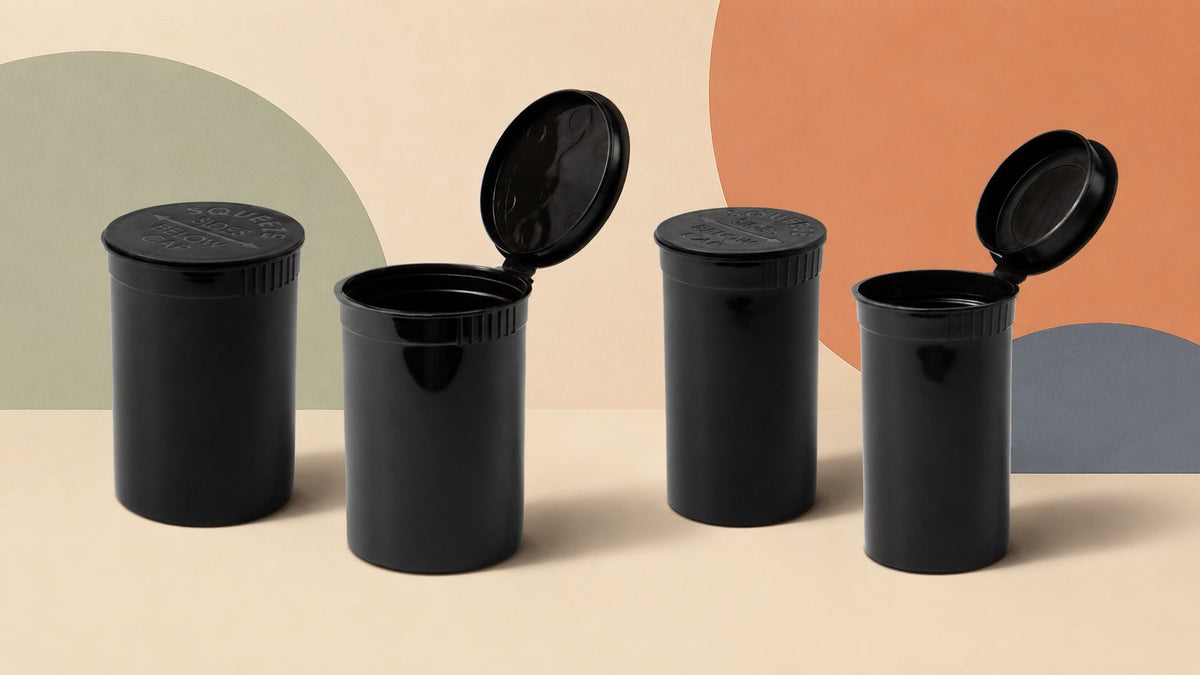
Use actual product samples to compare 19- and 30-dram PCR pop-top bottles by fill weight, headspace, closure operation, labeling, and production fit.
Choosing between a 19-dram and 30-dram cannabis bottle begins with the expected fill weight, but it should not end there.
Cannabis flower varies in density, moisture, trim, structure, and resistance to compression. Gummies and other edibles vary in dimensions, shape, coating, and unit count. Two products with the same labeled net weight may require different amounts of packaging space.
Use the nominal capacity to identify a starting point. Then test the actual product in samples before approving the bottle, label, tamper-evident feature, case quantity, or production process.
Sana Packaging currently offers two PCR pop-top bottle sizes:
| Bottle | Common starting capacity | Case quantity | Projects to evaluate |
|---|---|---|---|
| 19-dram PCR Pop-Top Bottle | Up to approximately 3.5g of cannabis flower | 416 bottles | Eighth-ounce flower programs, gummies, and other appropriately sized edibles |
| 30-dram PCR Pop-Top Bottle | Up to approximately 7g of cannabis flower | 272 bottles | Quarter-ounce flower programs, larger edible counts, or products requiring additional internal space |
These capacities are starting guidelines, not guaranteed fills.
Both bottles:
The main decision is not simply whether the target weight is closer to 3.5g or 7g. The bottle must accommodate the actual product while providing adequate headspace and reliable closure performance.
Document the product that will go into the bottle before selecting a size.
For cannabis flower, record:
For gummies or other edibles, record:
Do not rely on a different strain, formulation, flavor, or product from an earlier project without confirming that its packaging requirements are comparable.
The 19-dram bottle is the logical first sample for many products sold as approximately 3.5g of flower. The 30-dram bottle is the logical first sample for many products sold as approximately 7g.
That does not mean every eighth belongs in a 19-dram bottle or every quarter belongs in a 30-dram bottle.
A dense flower may occupy substantially less space than a lighter, less compact product at the same weight. Large flower structures may require more room to avoid excessive compression. A gummy count may fit by volume but still require additional space for efficient filling or acceptable presentation.
When the expected fit is close, test both sizes. The cost of evaluating another sample is usually lower than the cost of approving an unsuitable production configuration.
Use samples from the actual product or a representative production batch.
Do not test only one ideal unit.
For the flower, include samples that represent the expected variation in density, structure, moisture, and trim. For edibles, include the expected variation in dimensions, coatings, shapes, and unit counts.
Fill each bottle using the same method planned for production.
Record:
Evaluate the product near the expected low and high ends of its production range.
A bottle that works only with the most compact flower or smallest edible units may not provide a reliable production standard.
Too little headspace can interfere with closing, compress the product, or create inconsistent fills. Excessive headspace can affect presentation and may allow more product movement during handling.
Define an acceptable range rather than relying on a visual judgment made from one sample.
Repeat the fill-and-closure process across enough samples to identify normal variation.
One successful fill indicates that the product fits. A repeatable test helps establish whether the configuration is practical for routine production.
Both bottle sizes use an integrated child-resistant pop-top closure.
Evaluate the closure after the bottle has been filled, labeled, stored, and handled under conditions representative of the finished product.
Confirm:
Child resistance comes from the tested package design and closure mechanism. It does not come from the PCR material, label, or tamper band.
Confirm the current certification and regulatory requirements for the exact package and market. Child-resistant does not mean child-proof.
The 19-dram and 30-dram bottles require separate label templates because their dimensions and printable areas differ.
Do not resize approved artwork from one bottle and assume that it will work on the other.
Use the correct size-specific template and test:
If Sana Packaging will print and apply the labels, confirm the selected bottle, label material, finish, artwork version, application requirements, and quantity for each SKU before proof approval.
The integrated pop-top closure provides child resistance, but the bottle is not automatically tamper-evident.
If visible evidence of opening is required, evaluate a compatible tamper band, label, seal, or other documented feature as part of the complete package.
The selected feature should:
Test the complete configuration rather than evaluating the bottle, label, and tamper-evident component independently.
Package testing should reflect the conditions the filled product is expected to encounter.
Depending on the project, evaluate:
Inspect the bottle, closure, label, tamper-evident feature, and product after testing.
Do not assume that a pop-top bottle is completely airtight, odor-proof, moisture-proof, leakproof, or suitable for every formulation. Package performance depends on the complete configuration and the conditions in which it is filled, transported, stored, and used.
Once testing is complete, document the approved configuration.
Include:
Keep the approved standard with the purchase order, artwork, proofs, test results, and production records.
Reconfirm the configuration if any of the following change: the product, formulation, fill weight, bottle, color, label, tamper-evident feature, filling process, or regulatory requirements.
The molded bottle is made from 100% post-consumer recycled polypropylene.
That claim should not automatically be applied to labels, inks, adhesives, tamper bands, outer packaging, or other components used in the finished system.
Recycled content also does not independently establish recyclability, child resistance, tamper evidence, food-contact suitability, or the package's overall environmental impact.
Use “recyclable where accepted” for the #5 polypropylene bottle rather than claiming that it is recyclable everywhere. Local acceptance can depend on color, size, labels, residual product, collection systems, and sorting infrastructure.
For broader PCR definitions, sourcing information, documentation, and environmental-claim guidance, use Sana Packaging’s Post-Consumer Recycled Materials FAQ.
The 19-dram bottle is a practical starting point for many approximately 3.5g flower projects. The 30-dram bottle is a practical starting point for many approximately 7g projects.
The final decision should be based on repeatable testing with the actual product.
Compare the sizes, document the fill, evaluate headspace and closure operation, test the complete labeled and tamper-evident configuration, and preserve the approved production standard.
Explore PCR Pop-Top Bottles or contact the Sana Packaging team to request samples and discuss product fit, case quantities, labels, custom colors, and production requirements.
Last reviewed: August 27, 2026.
Product availability, colors, case quantities, customization options, pricing, certifications, and production timelines can change. Confirm current information and test the complete filled package before placing a production order.
Related resources: Post-Consumer Recycled Materials FAQ; Containers & Bottles; Post-Consumer Recycled Material.

Learn how to evaluate cannabis edibles packaging by child resistance, barrier performance, food-contact suitability, serving format, labe...
Our expert team can take care of it. Just click Get Expert Install and we'll send you an email when it's ready!
If everything looks okay to you, you can Ignore this warning.


