
Metal Packaging for Cannabis: Formats, Product Fit, Printing & Recycling
Learn how to evaluate metal cannabis packaging by material, product fit, closures, inserts, printing, labeling, recycling, and production...


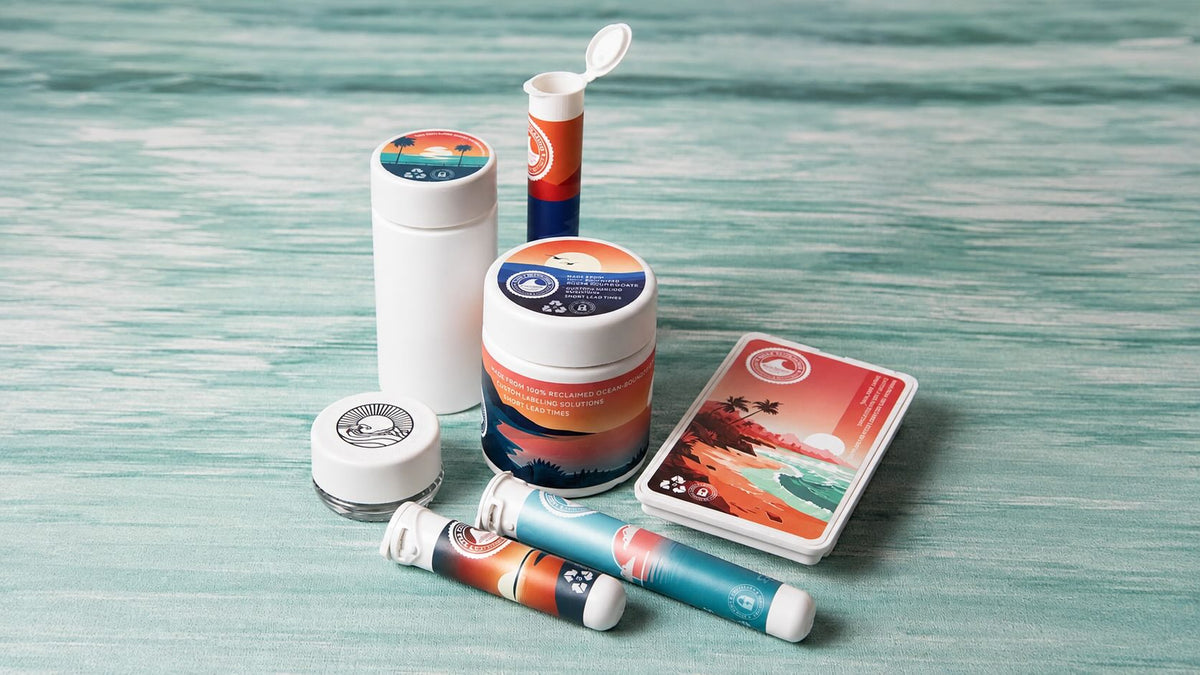
Learn how land-recovered post-consumer plastic becomes Sana Packaging products, what “100% reclaimed” applies to, and how to assess claims and disposal.
Ocean-bound plastic is not plastic recovered from the ocean.
It is post-consumer plastic collected on land in qualifying communities where formal waste-management infrastructure is absent or inadequate, within approximately 50 kilometers of a shoreline.
The term identifies a documented collection origin. It does not independently establish that the material came from a beach, river, waterway, coastline, nearshore environment, or open ocean.
It also does not prove that a particular piece of plastic would otherwise have entered the ocean.
Understanding these boundaries is essential when evaluating reclaimed ocean-bound plastic packaging and the claims made about it.
Ocean-bound plastic is a specific category of post-consumer recycled plastic.
For material to qualify, its sourcing documentation must support both the collection conditions and the location. Distance from a shoreline alone is not enough.
The applicable material is recovered:
The recovered plastic is then sorted and processed into material that may be used for another manufacturing application.
“Ocean-bound” describes where and under what conditions the plastic was collected. It does not describe where the finished package should be discarded.
Ocean-bound plastic should not be confused with plastic collected from an aquatic or shoreline environment.
It is not automatically:
These terms refer to different recovery locations or conditions and should not be used interchangeably unless documentation supports the exact description.
A package made with ocean-bound plastic should not be marketed as being made from ocean plastic, ocean waste, or plastic removed from the ocean.
Yes. Ocean-bound plastic is a specific type of post-consumer recycled material, commonly referred to as PCR.
“Post-consumer” means the plastic has completed its original intended use and entered a recovery pathway.
“Ocean-bound” adds information about the documented collection area and local waste-management conditions.
These descriptions answer different questions:
An accurate material description should address the applicable resin, its recycled content, and its sourcing classification.
The exact recovery and manufacturing processes depend on the resin, supplier, packaging, and production method.
A general pathway may include:
Recovery origin does not independently determine the material’s purity, performance, food-contact suitability, child resistance, tamper evidence, recyclability, or compatibility with a particular packaged product.
Those attributes require separate documentation or evaluation.
Sana Packaging relies on current supplier and sourcing documentation to support the reclaimed content, resin type, and qualifying ocean-bound origin of the material used in the applicable molded component.
Documentation for one material, production run, resin, or product should not automatically be applied to another.
Before making a claim, confirm:
Sourcing documentation does not independently establish a specific carbon-reduction, emissions-reduction, pollution-prevention result, life-cycle benefit, or end-of-life pathway.
For Sana Packaging’s current Ocean Packaging products, “100% reclaimed ocean-bound plastic” applies to the molded component supported by the product documentation.
Depending on the product, the complete packaging configuration may also contain:
Those components may use different materials and should be described according to their own specifications.
Do not apply a molded-component claim to the complete packaging system unless every component is covered by documentation supporting that claim.
Sana Packaging currently offers seven stock Ocean Packaging formats using reclaimed ocean-bound HDPE, PET, or PP.
| Product | Documented molded material |
|---|---|
| 78mm Ocean Tube | 100% reclaimed ocean-bound HDPE |
| 110mm Ocean Tube | 100% reclaimed ocean-bound PET |
| 116mm Ocean Tube | 100% reclaimed ocean-bound PP |
| 90mm Ocean Pre-Roll Multipack | 100% reclaimed ocean-bound PP |
| 4oz Ocean Jar | 100% reclaimed ocean-bound HDPE |
| 38-400 Ocean Screw-Top Lid | 100% reclaimed ocean-bound HDPE |
| 53-400 Ocean Screw-Top Lid | 100% reclaimed ocean-bound HDPE |
HDPE, PET, and PP are different resins. Documentation, package performance, component compatibility, and local recycling acceptance for one resin should not be applied to another.
Available products, materials, liners, colors, capacities, and configurations are subject to change. Confirm the current specifications for the exact product before approving a packaging system or making a claim.
Sana Packaging’s Ocean Packaging line uses three plastic resins:
Each resin has its own processing characteristics and potential packaging applications. The selected resin is only one part of the finished package.
Material identity does not independently establish:
Evaluate the exact package and complete configuration rather than assuming that every package made from the same resin will perform identically.
Applicable Sana Packaging Ocean Packaging products use food-grade, FDA-compliant material for their documented product-contact applications.
That statement is product-specific. It does not mean that every reclaimed ocean-bound material, package, liner, seal, label, or assembled configuration is suitable for every food, cannabis product, concentrate, edible, storage condition, temperature, or period of contact.
“FDA compliant” should not be changed to “FDA approved.”
Before approving a package for product contact, confirm:
Test the complete production-representative package with the actual product.
No. Material origin does not establish child resistance.
A package may use reclaimed ocean-bound plastic and also have a certified child-resistant design, but these are separate attributes supported by different documentation.
Confirm child resistance for the exact package and closure configuration.
Printing, labels, liners, seals, inserts, and tamper-evident features should not interfere with the package’s opening or closing mechanism.
Child-resistant does not mean child-proof.
Not automatically.
Child resistance and tamper evidence address different packaging requirements. A certified child-resistant closure does not, by itself, provide visible evidence that a package has been opened.
When tamper evidence is required, evaluate a compatible band, seal, label, or other documented feature for the exact package.
Test the complete configuration to confirm that the tamper-evident component:
Sana Packaging’s Ocean Packaging products use HDPE, PET, or PP, but local recycling acceptance varies.
The presence of a commonly recognized resin does not guarantee that a local program accepts the exact package format, color, size, closure, liner, label, or complete configuration.
Appropriate end-of-life steps may include:
Use “recyclable where accepted” only when it accurately describes the applicable component and local pathway.
Do not claim that Ocean Packaging is:
Reclaimed content and recyclability are separate attributes. A package can contain 100% reclaimed material without being accepted by every recycling program.
No. Sana Packaging’s current Ocean Packaging products should not be described as biodegradable or compostable.
HDPE, PET, and PP are conventional plastic resins. Reclaimed content changes the source of the material, not its classification as plastic.
Do not place an Ocean Packaging product in a composting program based on its reclaimed content.
Reclaimed ocean-bound plastic should not be described as:
Follow the recycling or disposal instructions applicable to the exact package and location.
Reclaimed ocean-bound plastic can offer useful packaging attributes.
Depending on the exact product, these may include:
The material and product line also have tradeoffs:
No material offers a universal packaging solution. Evaluate the complete package, documented claims, intended application, and available end-of-life pathway together.
Material claims should describe the supported source, resin, recycled content, and component without extending those facts into unsupported environmental outcomes.
Appropriate product-specific language may include:
Avoid unsupported or misleading descriptions such as:
Do not publish specific pounds recovered, carbon reductions, emissions savings, energy savings, waste-diversion results, or other impact figures unless a current source supports the exact material, package, time period, methodology, and claim.
Material sourcing is only one part of a packaging decision.
Before approving an Ocean Packaging product, evaluate:
Request samples and test the complete production-representative configuration under realistic conditions.
Do not rely on the material name alone to establish product compatibility, package performance, legal compliance, or customer disposal instructions.
Ocean-bound plastic is post-consumer plastic recovered on land in qualifying communities without formal or adequate waste-management infrastructure, within approximately 50 kilometers of a shoreline.
It is not plastic pulled from the ocean.
Sana Packaging’s current Ocean Packaging line uses product-specific reclaimed ocean-bound HDPE, PET, and PP. The “100% reclaimed ocean-bound plastic” claim applies to the molded component supported by the applicable documentation.
That claim should not be expanded into an unsupported statement about the entire packaging system, ocean cleanup, pollution prevention, carbon reduction, recyclability, biodegradability, compostability, regulatory compliance, or total environmental performance.
For detailed definitions, sourcing and documentation guidance, component-level claims, resin information, recyclability, and disposal considerations, use Sana Packaging’s Ocean-Bound Plastic FAQ after that page launches.
Explore the 78mm Ocean Tube, 110mm Ocean Tube, 116mm Ocean Tube, 90mm Ocean Pre-Roll Multipack, 4oz Ocean Jar, 38-400 Ocean Screw-Top Lid, and 53-400 Ocean Screw-Top Lid, or contact the Sana Packaging team to request samples and discuss product fit, documentation, closures, liners, printing, labeling, and compatible components.
Last reviewed: August 27, 2026.
Material sourcing, formulations, product availability, dimensions, capacities, liners, colors, case quantities, customization options, certifications, documentation, pricing, and production timelines can change. Confirm current information for the exact material, package, component, and intended use before placing a production order or making a product claim.
Related resources: Ocean-Bound Plastic FAQ; Reclaimed Ocean-Bound Plastic; Sustainability.

Learn how to evaluate metal cannabis packaging by material, product fit, closures, inserts, printing, labeling, recycling, and production...
Our expert team can take care of it. Just click Get Expert Install and we'll send you an email when it's ready!
If everything looks okay to you, you can Ignore this warning.


