
Cannabis Topical Packaging Guide: Jars, Compatibility & Labels
Learn how to evaluate cannabis topical packaging by jar size, material, product compatibility, closures, labeling, and customization. Thi...


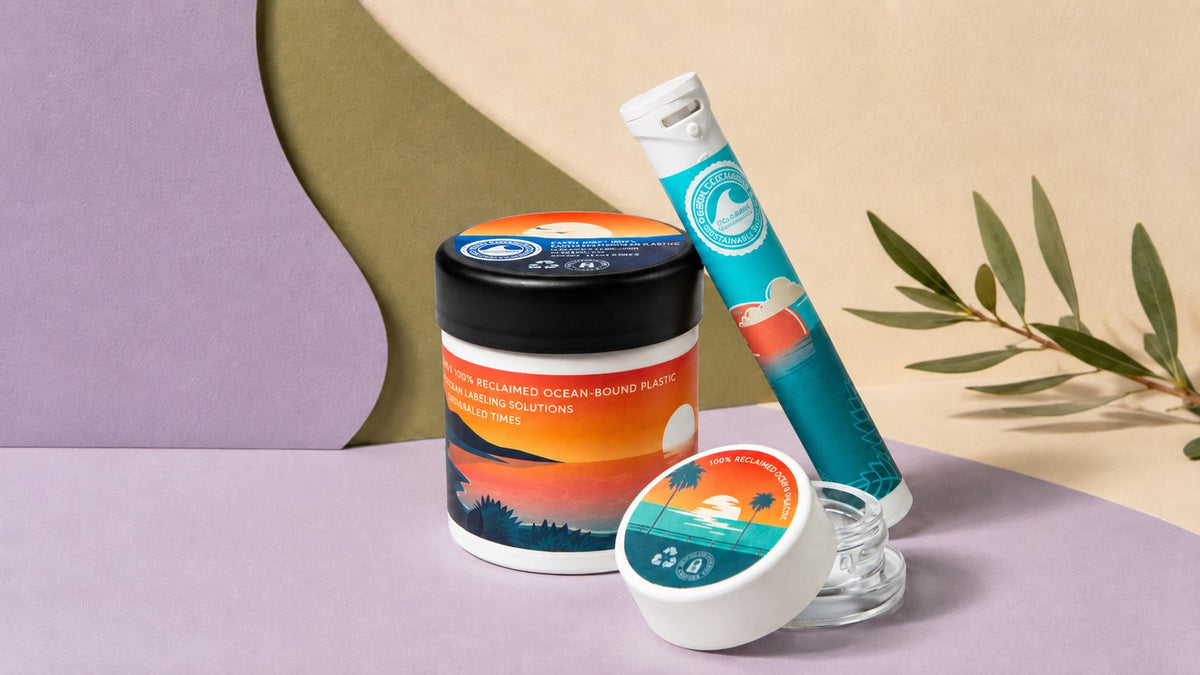
Compare Sana Packaging’s seven stock Ocean Packaging formats and learn how to plan colors, branding, liners, components, artwork, proofs, and production.
Custom reclaimed ocean-bound plastic packaging begins with one of Sana Packaging’s seven existing Ocean Packaging formats:
These are established stock products with product-specific dimensions, closures, colors, liners, components, artwork templates, and customization options.
A printing, labeling, liner, color, or component option available for one Ocean Packaging product should not automatically be applied to another. The correct starting point is the exact product and SKU—not a catalog-wide assumption about what “custom packaging” includes.
Depending on the selected product, available options may include:
Not every method is available for every product.
Custom colors generally begin at one pallet for applicable Ocean Packaging products. Because pallet quantities vary by product, the applicable custom-color minimum is the pallet quantity documented for the selected SKU—not a single unit count for the entire product line.
This article focuses on choosing among the seven existing formats and planning a product-specific customization project. For definitions, sourcing, material composition, supported claims, and end-of-life guidance, review Understanding Reclaimed Ocean-Bound Plastic Packaging.
Choose and test the stock package before designing the decoration around it.
Confirm the intended product, finished dimensions, fill quantity, required headspace, closure, liner or insert, child-resistance requirements, tamper-evident requirements, filling process, storage conditions, and intended markets.
The selected package determines which colors, branding methods, artwork templates, liners, and compatible components can be considered. It also determines the relevant case and pallet quantities, as well as production requirements.
Request samples and test the complete proposed configuration before approving artwork or production quantities.
Use this comparison to identify a starting product and customization path. The applicable product page, product-specific FAQ, artwork template, and current quote provide the final project requirements.
| Product | Stock and custom colors | Documented branding options | Product-specific components |
|---|---|---|---|
| 78mm Ocean Tube | White or black; custom colors starting at one pallet of 36,000 tubes | Label printing and application, pad printing, and digital printing | The two-piece closure is part of the established tube. Evaluate any tamper-evident feature separately. |
| 110mm Ocean Tube | White or black; custom colors starting at one pallet of 24,000 tubes | Label printing and application, pad printing, and digital printing | The two-piece closure is part of the established tube. Evaluate any tamper-evident feature separately. |
| 116mm Pop-Top Ocean Tube | White or black; custom colors starting at one pallet of 36,000 tubes | Label printing and application; direct printing for qualifying projects | The pop-top closure is part of the established tube. The current direct-print template identifies a separate 10,000-unit print minimum. |
| 90mm Ocean Pre-Roll Multipack | White or black; custom colors starting at one pallet of 15,000 multipacks | Label printing and application | An optional five-slot paper insert is sold separately. Confirm the insert and finished pre-roll dimensions together. |
| Product | Stock and custom colors | Documented branding options | Liner or component options |
|---|---|---|---|
| 4oz Ocean Jar | White; custom colors starting at one pallet of 7,500 jars | Printed wraparound labels, label application, and custom tamper bands | Compatible 53-400 lids are sold separately. Select and test the jar, lid, liner, label, and tamper-evident feature as a complete system. |
| 38-400 Ocean Screw-Top Lid | White or black; custom colors starting at one pallet of 37,500 lids | Label printing and application; full-color digital printing for qualifying projects | Stock lids use pre-inserted Esterfoil liners. The lid pairs with the 9ml Glass Concentrate Jar, 1oz Glass Jar, and 90mm Glass Pre-Roll Multipack Jar. Confirm any other sealing option before specifying it. |
| 53-400 Ocean Screw-Top Lid | White or black; custom colors starting at one pallet of 25,000 lids | Label printing and application and full-color digital printing | Smooth and pictorial-debossed styles are documented, along with pressure-sensitive and foam liner options. The lid pairs with the 4oz Ocean Jar and compatible 2oz, 3oz, and 4oz Recycled Glass Jars. Confirm the selected style, liner, and SKU when requesting a quote. |
The listed pallet quantities apply to custom molded colors. Printing, labels, label application, liners, sealing options, tamper-evident components, and design splits may have different minimum quantities.
Confirm the exact product, stock availability, custom-color quantity, number of designs, branding method, applicable template, component configuration, pricing, and production schedule before approving the project.
Once the package and complete component configuration have been selected and tested, build the customization project around that exact SKU.
Do not transfer artwork dimensions, print areas, color requirements, liner specifications, or component assumptions from a similar product. Two Ocean Packaging products may look similar even when using different templates, closure clearances, pallet quantities, or production methods.
Select a branding method documented for the chosen product.
The available route may involve labels, label application, pad printing, digital or direct printing, or a combination of compatible methods. Current availability depends on the exact product, artwork, quantity, design count, print area, and production requirements.
If a project includes multiple products, confirm the customization path for each SKU separately. Do not assume that a single approval, template, or production minimum covers the entire product line.
Request the current template for the selected product and branding method before finalizing the artwork.
A label template should not be treated as a direct-print template, and a template for one tube, jar, lid, or multipack should not be resized for another product.
Confirm:
Review the artwork at its intended production size. Small text, fine graphics, symbols, and barcodes may behave differently on the finished package than they do when enlarged on a screen.
Artwork preparation and regulatory review are related but separate responsibilities.
Sana Packaging can provide the applicable template, review whether submitted files are suitable for the selected customization process, and prepare a proof showing the planned artwork placement.
This support does not independently establish that the finished artwork complies with cannabis packaging, labeling, warning, symbol, testing, licensing, barcode, or market-specific requirements.
The brand placing the finished product on the market remains responsible for reviewing and approving its regulatory content in every jurisdiction where the product will be sold.
Complete that review before approving the final proof.
Printing, labels, liners, inserts, tamper-evident components, and other additions should not interfere with the package’s closing surfaces, moving parts, or opening mechanism.
Evaluate the customized package to confirm:
Child resistance applies to the documented package-and-closure configuration. A label, liner, insert, color, or tamper-evident component does not, by itself, make a package child-resistant.
Request current child-resistance documentation for the exact product and confirm that the proposed customization does not alter the documented configuration.
A child-resistant package is not automatically tamper-evident.
If visible evidence of opening is required, select a compatible tamper band, label, liner, seal, or other documented feature for the exact package.
Test the complete configuration to confirm that the tamper-evident feature:
Do not assume a tamper-evident component is compatible because it works with a similar jar, lid, tube, or multipack.
When requesting a quote, identify the exact product, stock or custom color, expected quantity, number of designs, quantity for each design, preferred branding method, required liners or components, tamper-evident requirements, shipping destination, target date, and artwork status.
For projects involving multiple Ocean Packaging products, provide this information separately for each SKU.
This allows the available methods, quantities, templates, components, pricing, and production schedule to be evaluated for the actual project rather than for Ocean Packaging as a general category.
Before production, review the proof for the exact product and design.
Confirm:
A proof shows the intended artwork and placement. It does not independently verify package fit, color appearance on the physical material, print durability, label adhesion, barcode performance, closure operation, liner performance, tamper evidence, or transportation performance.
When production-representative samples or applicable printed examples are available, evaluate the complete package under realistic conditions for filling, storage, handling, and transportation.
Do not approve the customized package based on artwork alone.
The phrase “100% reclaimed ocean-bound plastic” applies to the molded component supported by the documentation for the exact product.
A customized package may also include:
Those additions may use different materials. Do not apply the molded-component claim to the complete customized packaging system unless every included component is covered by documentation supporting the same claim.
Customization also does not establish ocean cleanup, pollution prevention, universal recyclability, regulatory compliance, or environmental superiority.
For material definitions, sourcing, claim guidance, and end-of-life considerations, review Understanding Reclaimed Ocean-Bound Plastic Packaging.
Once the project is approved, retain a packaging standard that identifies:
Keep the standard with the applicable quote, purchase order, artwork, proof, samples, product documentation, and production records.
Reconfirm the configuration if any of the following change: the package, artwork, color, printing method, label, liner, insert, tamper-evident feature, packaged product, filling process, storage conditions, or regulatory requirements.
Custom reclaimed ocean-bound plastic packaging starts with one of Sana Packaging’s seven existing Ocean Packaging formats.
Select and test the package first. Confirm the product-specific color, branding, liner, and component options. Use the correct artwork template. Complete the regulatory review separately. Protect the closure and child-resistant operation. Add tamper evidence when required. Review the proof, evaluate the finished configuration, and preserve the approved standard for production and reorders.
Use the product links in the comparison above to review the current formats. Explore Sana Packaging’s Customization Services, or contact the Sana Packaging team to request samples and discuss colors, printing, labels, liners, components, artwork, quantities, and production requirements.
Last reviewed: August 27, 2026.
Product availability, colors, dimensions, capacities, liners, components, customization methods, print areas, templates, minimum quantities, pricing, certifications, documentation, and production schedules can change. Confirm current information for the exact product and project before approving artwork or placing a production order.
Related resources: Ocean-Bound Plastic FAQ; Printing & Labeling FAQ; Reclaimed Ocean-Bound Plastic; Sustainability.

Learn how to evaluate cannabis topical packaging by jar size, material, product compatibility, closures, labeling, and customization. Thi...
Our expert team can take care of it. Just click Get Expert Install and we'll send you an email when it's ready!
If everything looks okay to you, you can Ignore this warning.


